
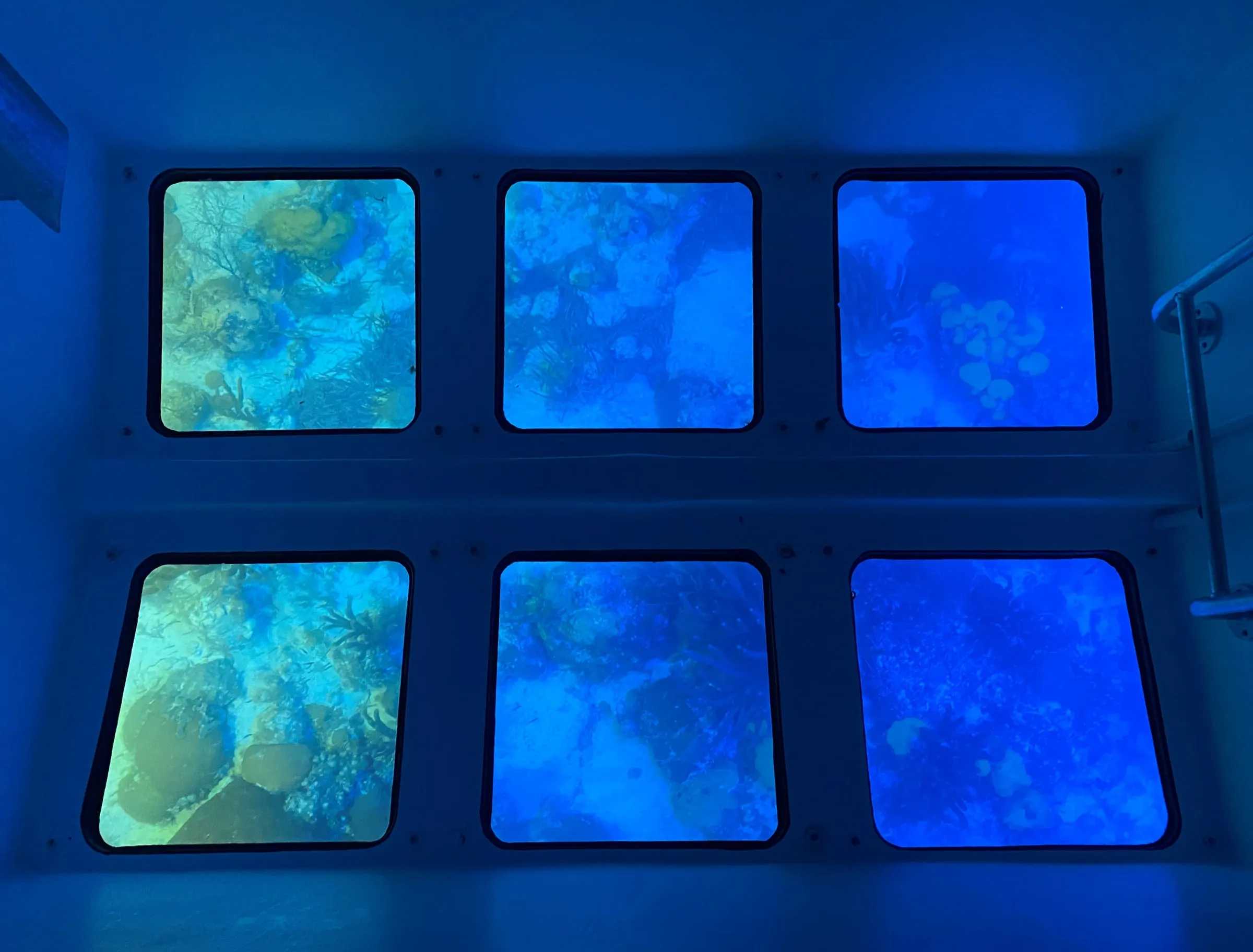
You do not have to get wet to see one of the most biologically diverse reef systems in the Western Hemisphere. The Florida Keys reef tract – the only living barrier reef in the continental United States – runs along the Atlantic edge of the archipelago holding sea turtles, eagle rays, moray eels, nurse sharks, and living coral formations that have been growing since before anyone thought to look at them through a glass-bottomed hull.
The Transparensea makes that viewing available to everyone, from non-swimmers to grandparents to children who have never been on a boat. It is a 46-foot glass bottom vessel built in 2023, operating out of Bass Pro Shop – World Wide Sportsman in Islamorada, and it carries one distinction that matters for any guest who has ever had a bad boat experience: it is the only Seakeeper-stabilized glass bottom boat in the state of Florida. Here is what the experience actually looks like and why those specifics change things for a lot of people.
One Thing to Know Before You Book: The Weather Backup Is Just As Good
Most glass bottom boat operators treat bad-weather days as a problem. The Transparensea treats them as a different experience. On days when offshore conditions make reef transit impractical, the tour routes through the shallow waters of Florida Bay on the Gulf side of the Keys – a seagrass estuary with a completely different species community: bottlenose dolphins actively hunting in the grass beds, manatees drifting through the warm shallows, American crocodiles visible from the water, and three species of rays crossing the sandy bottom below the hull.
Guests who booked a reef tour and were routed to Florida Bay consistently describe it as one of the best wildlife-watching hours of their Florida Keys trip. Saying this upfront matters: whatever the weather does, the two hours aboard the Transparensea are worth the booking.
Four departures daily – 9:30 AM, 12:00 PM, 3:00 PM, and the sunset night tour. Tour capacity is fixed and departures fill in advance. Check real-time availability at glassbottomtour.com or call (305) 214-5277 to hold your seats.
What Makes the Transparensea Different From Every Other Option
Seakeeper Stabilization – The Only One in Florida
Seakeeper is a gyroscopic stabilization system that counteracts vessel roll by up to 95 percent. On a conventional glass bottom boat in the Florida Keys’ offshore chop, a day with any wind means the hull is moving through the water and everything visible through the windows is in motion. On the Transparensea, the boat stays steady while the water moves around it.
In practical terms: guests who cannot tolerate conventional boat trips complete this tour without issue. Elderly passengers, young children, guests with vestibular sensitivities, and anyone who has been sick on a boat before consistently describe the Seakeeper as what made this specific tour work when others have not. No other glass bottom boat in Florida runs this system – this is not a marketing claim. It is a documented equipment distinction.
Marine Science-Educated Guides
The Transparensea guides are trained in marine science and provide live identification and ecological context for everything visible through the viewing windows – coral species and their growth stages, fish behavior, the predator-prey relationships playing out in the reef below, and honest current context on the health pressures the Florida Keys reef is navigating. Guests consistently describe the educational narration as the element that elevated the experience beyond a boat ride. It is the difference between seeing a sea turtle and understanding what that sea turtle is doing and why.
Night Tours With Underwater Lights
The Transparensea operates the only Glass Bottom Eco Tour at Night in Islamorada. The vessel’s underwater lighting system illuminates the reef after dark, revealing nocturnal species and behaviors that daytime touring literally cannot access – moray eels hunting in the open, octopuses crossing the reef face, spiny lobsters on foraging runs, and the bioluminescent organisms that fire in the water column around the lit hull. The night tour starts with the sunset; here is what the night tour is like.
Located at Bass Pro Shop – World Wide Sportsman in Islamorada
Transparensea glass bottom boat tours depart from Bass Pro Shop – World Wide Sportsman, 81576 Overseas Hwy, Islamorada, FL 33036.
What You See Through the Glass
The Reef Itself
The Transparensea visits Cheeca Rocks, Alligator Reef, and Caloosa Rocks – three distinct sections of the Florida Reef Tract, each with different depth profiles, coral architecture, and species communities. The 16 hull windows are set into the floor beneath passenger seating and provide a direct downward view at typical reef viewing depths of 10 to 25 feet. The coral formations visible include brain corals potentially 500 years old, staghorn and elkhorn in growth and recovery stages, sea fans and sponges standing in the current, and the three-dimensional structure of a living reef system.
The Species
The Florida Keys reef supports over 6,000 marine species. Through the hull windows on a standard reef tour, you can expect schools of sergeant majors, parrotfish, blue tang, and snapper; moray eels in crevices; nurse sharks on sandy patches; spotted eagle rays at mid-water; and green and loggerhead sea turtles that surface near the vessel regularly. The guides identify and contextualize everything that appears below – not just the name, but what is actually happening in the behavior you are watching.
Tour Logistics
Transparensea Glass Bottom Boat – Islamorada, FL
Tour details
Transparensea Glass Bottom Boat – Islamorada, FL
| Detail | Information |
|---|---|
| Duration | Approximately 2 hours |
| Departures | 9:30 AM 12:00 PM 3:00 PM 20 min after sunset |
| Check-in | 30 minutes before departure |
| Location | Bass Pro Shop – World Wide Sportsman 81576 Overseas Hwy, Islamorada, FL 33036 |
| Vessel | 46-foot glass bottom boat, Seakeeper stabilized Built 2023 |
| Viewing windows | 16 windows in the hull beneath seating |
| Shade | Full canopy – no direct sun exposure |
| Restroom | On board |
| Seasickness risk | Minimal – Seakeeper reduces roll up to 95% |
| Beverages | Soda and water available for purchase aboard |
| What to bring | Camera, sunscreen, sunglasses, cash for guide gratuity |
| Booking | glassbottomtour.com · (305) 214-5277 |
Who This Tour Is For
The glass bottom format removes the physical requirements of snorkeling while delivering a genuine reef experience. It is genuinely suitable for guests across a range that other reef tour formats exclude:
- Families with young children who cannot or should not snorkel in open water
- Non-swimmers and guests not comfortable in open ocean
- Elderly guests or anyone with physical limitations that make water entry impractical
- Guests with a history of seasickness – the Seakeeper system changes the equation for this group specifically
- Visitors who want educational depth alongside the visual experience
- Experienced divers and snorkelers wanting the top-down perspective through stable glass – the hull view is genuinely different from the in-water perspective
For groups of mixed abilities – families where some members swim confidently and others do not – the glass bottom boat is the format that delivers an equivalent, complete experience to every person aboard. No one is sitting on the boat watching others snorkel.
Which Departure Time Is Right for Your Group
- 9:30 AM: clearest water and lowest reef boat traffic of the day. Best for young children, first-time visitors, and anyone who wants the most consistent viewing conditions.
- 12:00 PM: peak midday light, active feeding behavior visible, warmest temperature aboard.
- 3:00 PM: afternoon light, typically lighter crowd volume, returns before the dinner window.
- Sunset night tour: a completely different experience – nocturnal species, underwater lights, bioluminescence. Read more about the night tour.
For most families, the 9:30 AM departure is the most recommended: calm seas, clear water, and children at full attention before the afternoon heat sets in.
Frequently Asked Questions
Is the glass bottom boat tour good for people who get seasick?
It is specifically the right option. The Seakeeper stabilization system reduces vessel roll by up to 95 percent – this is verified equipment performance, not a comfort claim. Guests who have been unable to complete boat tours elsewhere complete this one regularly without incident. The morning departure typically encounters the calmest sea conditions of the day; if seasickness is a serious concern, the 9:30 AM tour is the safest choice.
What age is appropriate for the glass bottom boat?
All ages. There is no minimum. The boat is fully shaded, seating is bench-level with windows directly below, a restroom is on board, and the educational narration is designed to engage children and adults equally. Guides are experienced with family groups and adjust their narration to the audience aboard.
What happens if the weather is bad?
Bad offshore conditions route the tour to Florida Bay rather than the Atlantic reef – a different ecosystem with dolphins, manatees, and rays that many guests describe as equally excellent. If conditions require full cancellation, the team contacts booked guests directly and offers rescheduling. The weather backup is genuinely good – not an apology.
Should I book in advance or can I walk up?
Book in advance. The Transparensea is a single vessel with fixed capacity, and specific departures – particularly the 9:30 AM and night tour – fill ahead of time. Walk-up availability exists on lower-traffic weekdays but cannot be relied upon for peak season weekends or holiday periods. Booking at glassbottomtour.com takes three minutes and confirms your seats.
The reef is there year-round. Your free afternoon might not be. Book your Transparensea departure at glassbottomtour.com – four times daily, night tour available. Call (305) 214-5277 with questions or to book by phone.