
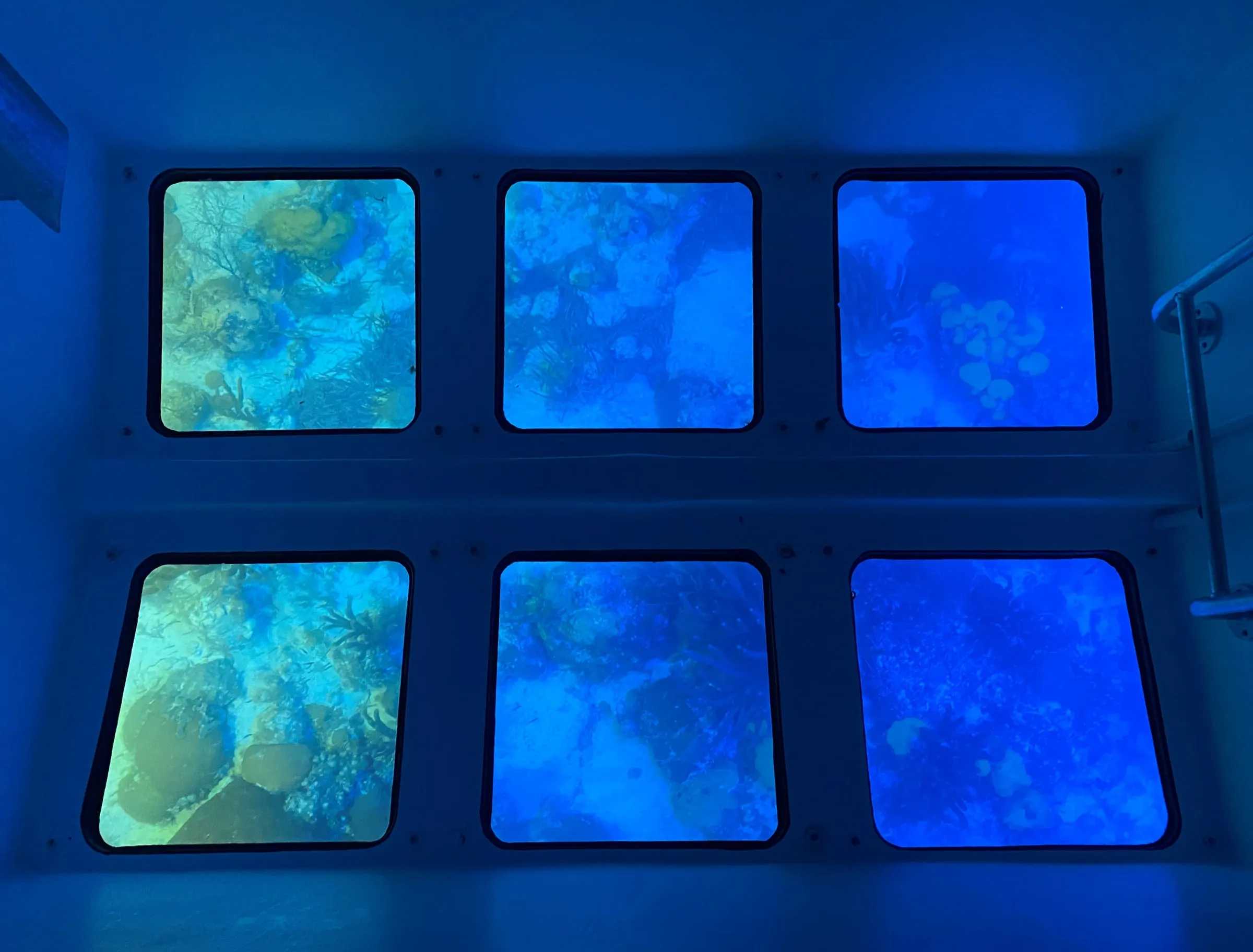
If you are planning a trip to the Florida Keys and you want to see the reef, you have probably already discovered that “the reef” is not one place. The Florida Reef Tract runs 360 miles along the Atlantic edge of the Keys. The section accessible from Islamorada holds some of the most biologically active sites in the entire system – each with a different depth profile, coral architecture, and resident species community.
Three of those sites are the ones the Transparensea glass bottom boat visits on a rotating basis: Cheeca Rocks, Alligator Reef, and Caloosa Rocks. Here is what each one actually holds – the coral, the fish, the large animals – and what a visit to each one typically produces.
The Florida Keys Reef System: What You Are Looking At
The Florida Reef Tract is the only living barrier reef in the continental United States and the third-largest reef system in the world, after Australia’s Great Barrier Reef and the Mesoamerican Reef off Central America. It formed approximately 7,000 years ago as sea levels rose after the last glacial period, flooding the shallow limestone shelf of South Florida and allowing coral larvae to settle and begin building.
The reef is protected within the Florida Keys National Marine Sanctuary – 2,900 square nautical miles of managed marine environment established in 1990. Anchoring on coral is prohibited, fishing is regulated, and the reef’s access is structured to balance public use with long-term ecosystem health.
The reef’s condition varies across the system and across time. Bleaching events in 1998, 2005, 2014, and 2023 caused mortality across sections of the reef. Active restoration programs – most notably the Coral Restoration Foundation’s nursery operations in the Keys – have been replanting coral fragments at degraded sites since the early 2000s, with measurable recovery in targeted areas. The Transparensea guides give current, honest reef health context during tours, not an idealized version of what the reef was in 1985. Visiting it now, with that context, is more interesting than visiting a theme park representation of what it once was.
The best way to see these three reef sites from Islamorada without getting wet: the Transparensea glass bottom boat with marine science-educated guides. Check current availability at glassbottomtour.com or call (305) 214-5277.
Cheeca Rocks
What It Is and Why It Matters
Cheeca Rocks is a shallow patch reef approximately three miles offshore from Islamorada, at depths of 2 to 15 feet. It has been one of the most intensively studied reef sites in the Florida Keys for decades – its proximity to the Cheeca Lodge property and its position as a long-term monitoring reference site have made it the subject of sustained scientific observation and restoration work.
The shallow depth is Cheeca Rocks’ defining characteristic for visitors. At 2 to 3 feet at the shallowest sections, the reef is close enough to the hull at low tide that the Transparensea’s viewing windows provide an almost eye-level encounter with the coral surface. On the right morning, the brain coral formations – some approaching the size of a dining table, potentially 500 years old – are visible in detail sufficient to distinguish individual coral polyps.
What You’ll See
Cheeca Rocks is consistently the most reliable site in the Upper Keys for sea turtle encounters. Green sea turtles use the adjacent seagrass beds for feeding and the reef structure for resting – they are present year-round and frequently approach or surface near the Transparensea hull. Loggerhead sea turtles, recognizable by their larger size and reddish-brown shell coloration, pass through less predictably but are regularly observed. For many guests, the turtle encounter at Cheeca Rocks is the defining moment of their Florida Keys water experience.
Beyond the turtles, the fish community at Cheeca Rocks is dense and active. Large schools of blue tang and parrotfish move in coordinated feeding formations across the reef surface. Moray eels occupy crevices throughout the structure – multiple species, multiple sizes, with the green moray’s distinctive coloration visible from the hull windows at this depth. Nurse sharks rest on sandy patches between coral heads. Barracuda hold station in the midwater column above the reef, motionless in a way that makes them look carved from the water. On the right day, spotted eagle rays transit the area in the water column between the hull and the reef.
A note on lionfish: the invasive Indo-Pacific lionfish has established throughout the Atlantic reef system including Cheeca Rocks. They are visible during tours and the guides explain their status – one of the clearest current-events reef ecology discussions available on any Florida Keys water tour.
Alligator Reef
What It Is and Why It Matters
Alligator Reef is a bank reef approximately four miles offshore, at depths of 8 to 30 feet, marked by the Alligator Reef Lighthouse – an 1873 iron-screw pile structure standing 136 feet above the water and listed on the National Register of Historic Places. The lighthouse was built here because the reef claimed significant ship traffic in the nineteenth century, including the USS Alligator in 1822, for which the reef is named.
Alligator Reef is the most topographically varied of the three main Transparensea destinations. The outer edge drops to 30 feet and forms vertical walls with overhangs and ledges that shelter larger species than the shallower patch reefs. The inner sections are accessible to hull-window viewing at the typical depths the Transparensea operates.
What You’ll See
Alligator Reef produces the largest individual animal encounters of the three sites. Goliath grouper – federally protected since 1990, with individuals exceeding 400 pounds and 7 feet in length – are documented residents of the deeper reef structures and visible from the Transparensea at the shallower inner sections. Seeing a goliath grouper through a glass bottom window stops conversations. Nothing in the Florida Keys reef system is larger.
Caribbean reef sharks are more regularly observed at Alligator Reef than at most other Upper Keys sites, moving through the deeper sections adjacent to the outer reef drop. Southern stingrays rest in the sandy channels between coral structures throughout the inner reef. Hogfish – a wrasse species identifiable by a distinctively tapered snout – appear in sizes and densities uncommon at shallower sites. Green moray eels at Alligator Reef reach the largest sizes in the Upper Keys reef system.
The lighthouse foundation itself is worth watching during positioning approaches: the iron pilings below the waterline support a dense encrusting community of barnacles, tunicates, cup corals, and sponges that turn the man-made structure into an artificial reef visible from the hull at close range.
Caloosa Rocks
What It Is and Why It Matters
Caloosa Rocks is a shallow nearshore reef at depths of 3 to 12 feet, located in the transitional zone between the offshore Atlantic reef and the nearshore hardbottom communities of the Florida shelf – approximately two miles off the southwest shore of Upper Matecumbe Key. It is the shallowest of the three Transparensea destinations and frequently provides the closest glass-bottom hull-to-reef viewing distance.
The character of Caloosa Rocks is different from the other two sites. Rather than a continuous reef structure, it is scattered hardbottom – irregular limestone formations colonized by a mix of soft and hard coral – interspersed with extensive seagrass beds. The species community reflects this transitional position: both reef-associated species and those more characteristic of the nearshore seagrass environment.
What You’ll See
Caloosa Rocks is the most likely of the three sites to produce manatee encounters. West Indian manatees use the seagrass beds adjacent to the reef structure throughout the year, particularly during winter months when they concentrate in the warmer nearshore waters of the Keys. A manatee drifting through the grass bed below the Transparensea hull at 5 feet of depth – visible in full detail from the glass windows – is an encounter that the offshore reef sites almost never produce.
The seagrass beds at Caloosa Rocks also function as nursery habitat for juvenile reef fish, creating a species size range visible on a single tour: juvenile surgeonfish, snapper, and grunt in the grass beds below the hull, adult specimens of the same species at the adjacent reef structure. For guests interested in reef ecology, this visible life-stage sequence – the relationship between seagrass nursery and reef adult habitat – is one of the clearest demonstrations of the Florida Keys ecosystem functioning as a connected system.
Spotted eagle rays are encountered more frequently at Caloosa Rocks than at the offshore sites, preferring the sandy nearshore habitat for foraging. Bonefish and permit – highly valued flats gamefish – occasionally appear in the grass bed sections, unusual reef tour sightings that reflect the site’s transitional position in the Keys ecosystem.
Florida Bay: When the Atlantic Reef Is Unavailable
On days when wind or swell conditions make offshore reef transit impractical, the Transparensea routes through Florida Bay – the shallow seagrass estuary on the Gulf side of the Keys. This is not a consolation experience. It is a different ecosystem with species and encounters not available at any of the three reef sites.
Florida Bay is one of the most important marine mammal habitats in the state of Florida. The bottlenose dolphin population in Florida Bay is among the most studied in the world – the dolphins actively hunt in the seagrass beds in behavioral patterns visible from the glass hull in a way that open-ocean dolphin encounters are not. West Indian manatees concentrate in Florida Bay during cooler months in numbers higher than any of the reef sites. And Florida Bay is one of the few locations in Florida where the American crocodile – distinct in species and in behavior from the alligator – is regularly observed from the water.
Guests who were routed to Florida Bay instead of the reef consistently describe the wildlife density and quality of encounters as equal to or exceeding what they expected from the reef. The shift-change framing is honest: the reef is extraordinary. Florida Bay is extraordinarily different. Neither is a lesser experience.
Frequently Asked Questions
Which Florida Keys reef site is best for seeing sea turtles?
Cheeca Rocks. Green sea turtles are present at Cheeca Rocks year-round, using both the seagrass beds for feeding and the reef structure for resting. The 2-to-15-foot depth range at Cheeca Rocks means turtles are frequently visible through the Transparensea hull windows at close range – not as distant shapes in the water column, but as individual animals whose shell markings and behavior are clearly distinguishable. Loggerhead turtles appear less predictably at all three sites.
What is the best time of year to see the Florida Keys reef?
The Florida Keys reef is accessible year-round. Water clarity is typically highest from November through April, when calmer winds and lower rainfall keep the nearshore water clear. Summer water temperatures exceed 85°F and are comfortable for swimming, but afternoon storm systems from June through September require schedule flexibility. Sea turtle nesting season runs April through September; nesting females are more frequently encountered at nearshore sites during this period. The reef is worth visiting in any month – the species composition and behavioral patterns shift with season in ways the guides contextualize during the tour.
Is the Florida Keys reef in decline?
Parts of it have experienced significant stress and coral mortality, particularly following the 2023 bleaching event when ocean temperatures in the Keys reached record levels for an extended period. The reef is not what it was in 1985. It is also not static or deteriorating without response: active coral restoration programs have been replanting coral fragments at degraded sites in the Keys for over two decades, and recovery is measurable in targeted areas. The Transparensea guides give current, honest reef health context during tours – including both the pressures the reef faces and the restoration work underway. Visiting with accurate context produces a more meaningful experience than visiting with idealized expectations.
Can I visit Cheeca Rocks or Alligator Reef on my own?
Yes, with certain requirements. Both sites are within the Florida Keys National Marine Sanctuary. Anchoring on coral is strictly prohibited – vessels must anchor in sand only. Alligator Reef and Cheeca Rocks are popular snorkeling and diving destinations for visitors with private boats or chartered vessels from Islamorada operators. For visitors without their own vessel, the Transparensea glass bottom tour is the most accessible and most guided way to visit these sites – and the only option that includes marine science narration throughout the visit.
These three reefs are what the Transparensea visits – with a marine scientist narrating every species and formation visible through the glass. Book your tour at glassbottomtour.com. The 9:30 AM departure offers the clearest water of the day. The sunset night tour shows you what these same reefs become after dark – the only night glass bottom tour in Islamorada.