
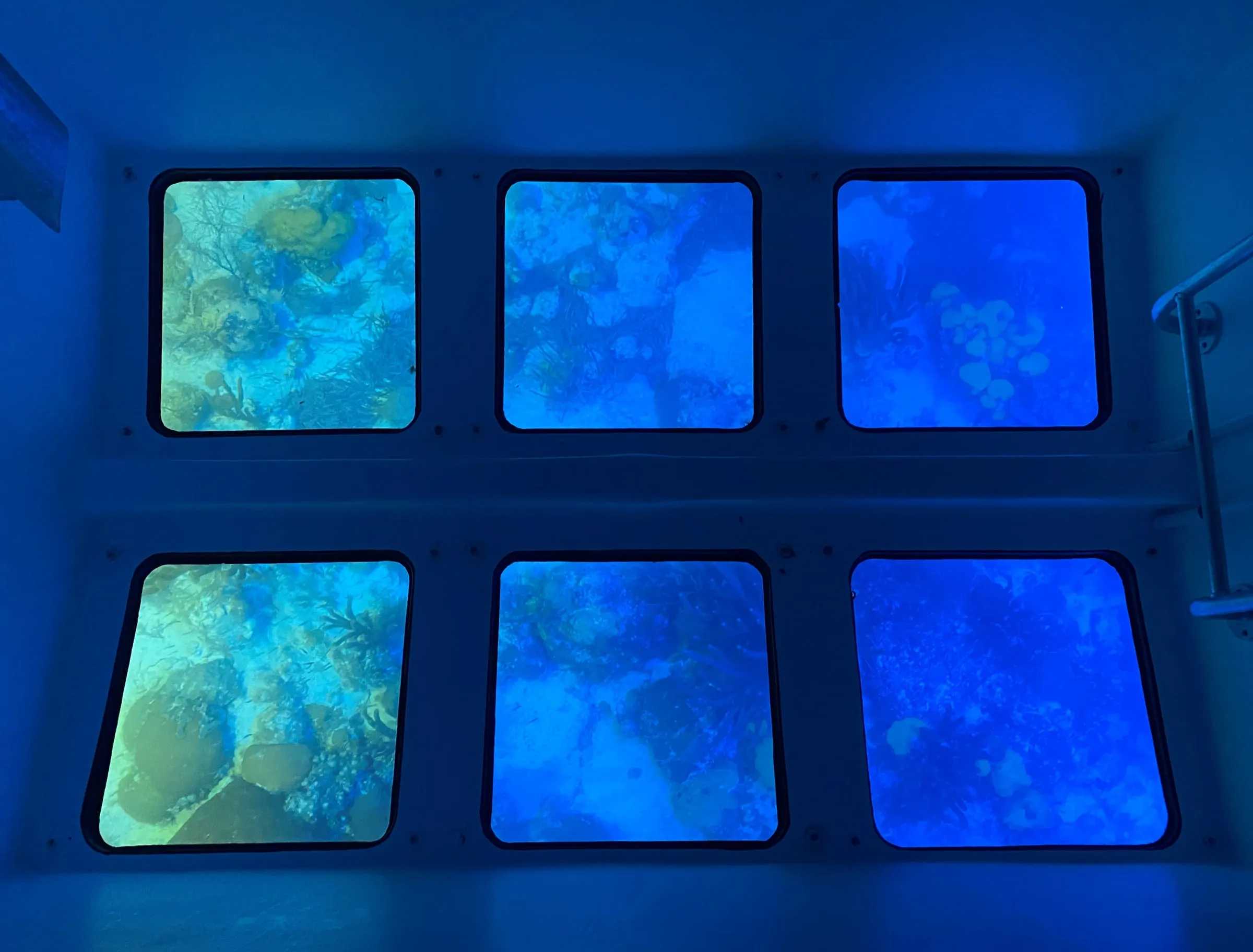
Here is the situation most Florida Keys visitors face: you want to see the reef. You have heard both options mentioned and you are not sure which one to book. The reef is the same either way – Cheeca Rocks, Alligator Reef, the living coral of the Florida Reef Tract. The experience is not.
One puts you in the water above the reef, physically present in the ocean. The other puts you above the reef in a dry, guided, stabilized boat with a marine scientist narrating what you are looking at. Both options are genuinely good. Getting the choice wrong means either spending two hours in the water wishing you had not, or sitting on a boat wondering what the water would have felt like. Here is the honest breakdown.
What Snorkeling in the Florida Keys Actually Delivers
Snorkeling in the Florida Keys is as immersive as reef access gets without a dive certification. At Cheeca Rocks and Alligator Reef, visibility on good days reaches 40 to 60 feet – you are floating at the surface looking down through clear water at a living reef system in three dimensions. Fish that maintain their distance from a vessel approach snorkelers at close range. Sea turtles pass at arm’s length. The depth and vertical architecture of the reef – the overhangs, the vertical walls, the crevices where morays sit – is perceptible in a way that no hull window can convey.
For confident swimmers comfortable in open ocean conditions, snorkeling the Florida Keys reef is one of the best underwater experiences available in North America without a scuba tank. If that describes your group, the recommendation is to snorkel.
Snorkeling is the better choice when:
- Everyone in your group swims confidently and is comfortable in open ocean water with current
- You want maximum physical proximity to the reef – floating above, free-diving down, touching the experience
- Your group has no significant motion sickness history and is comfortable in conditions that can be choppy offshore
- Children are strong swimmers who will not need flotation assistance or constant supervision in open water
What the Transparensea Glass Bottom Boat Delivers
The Transparensea is a 46-foot vessel with 16 glass windows set into the hull directly beneath passenger seating. The reef passes below at 10 to 25 feet as the boat positions over the reef structures, with marine science-educated guides narrating every species and formation visible through the glass in real time. You are dry, shaded, stable – and watching the same reef that snorkelers are in the water above.
The Seakeeper stabilization system on the Transparensea reduces vessel roll by up to 95 percent. This is the specification that changes the decision for a significant portion of visitors who have experienced motion sickness on boats before. No other glass bottom boat in Florida runs this system.
The glass bottom boat is the better choice when:
- One or more people in your group cannot or will not enter open ocean water – non-swimmers, young children, elderly guests, guests with physical limitations
- Anyone in the group has experienced motion sickness on boats – the Seakeeper makes the Transparensea a different proposition from any other vessel
- You want live, expert-guided context on everything you are seeing – the narration is not a bonus, it is a central feature
- You want the night reef experience: the Transparensea runs the only glass bottom night tour in Islamorada, with underwater lights and nocturnal species inaccessible to snorkeling tours
- Your group has mixed ability levels and you want everyone to have an equivalent experience, not a divided one where swimmers snorkel and non-swimmers wait on the boat
The Transparensea is the only option for groups with mixed swimming ability – and the only night reef tour in Islamorada. Check availability and current pricing at glassbottomtour.com or call (305) 214-5277.
The Direct Comparison
Glass bottom boat vs. snorkeling tour
Side-by-side comparison – Islamorada, FL
| Factor | Glass bottom boat (Transparensea) Featured | Snorkeling tour |
|---|---|---|
| Reef access | Through 16 hull windows, 10–25 ft depth | Surface level above coral, can free-dive deeper |
| Physical requirement | None – fully seated, no water entry | Must swim, use fins and mask in open ocean |
| Non-swimmers | Fully accessible – no limitation | Not accessible without flotation aid |
| Children under 8 | Ideal – seated, shaded, stable | Age and ability dependent; requires supervision |
| Motion sickness | Minimal – Seakeeper reduces roll 95% | Higher on choppy days, worse in swell |
| Expert narration | Yes – marine science-trained guides throughout | Varies; typically minimal or self-guided |
| 3D reef perception | Top-down view through glass | Full 3D – depth, height, overhang visible |
| Night experience | Yes – only night glass bottom tour in Islamorada | Night reef snorkeling not offered publicly |
| Duration | 2 hours guided | Typically 2–3 hrs including vessel transit |
| Best for | Mixed groups, families, first-timers, all ability levels | Confident swimmers wanting full immersion |
| Pricing | glassbottomtour.com for current tickets | Varies by operator – typically similar per-person range |
The Honest Recommendation for Each Type of Group
Families with Young Children
Glass bottom boat. The seated, shaded, stable environment of the Transparensea is purpose-built for the family group that includes children of different ages and abilities. The educational narration engages children in a way that floating above a reef does not – a guide who can point through the glass and say “that parrotfish is eating the coral and pooping sand – that’s where beaches come from” creates a memory that outlasts the experience. Snorkeling can be added for older children who want it, but the glass bottom boat is the right anchor for the family visit to the reef.
Couples and Adults
Depends on swimming comfort and what you want from the experience. If you are both comfortable swimmers who want the physical experience of being in the water above one of the world’s great reef systems, snorkel. If one of you gets seasick, has any hesitation about open ocean swimming, or if you want the narrated, educational depth of the Transparensea experience – the glass bottom boat wins. The night tour specifically is an evening on the water that most couples who have done it describe as the most distinctive experience of their Florida Keys trip.
Groups With Mixed Ability
Glass bottom boat, without qualification. A snorkeling tour that accommodates 8 of 10 people in a group does not accommodate the group. The glass bottom format delivers an equivalent reef experience to every passenger regardless of swimming ability, physical condition, or age. For any group where the snorkeling decision would leave one or two people waiting on a boat watching others in the water, the glass bottom tour is the decision that includes everyone.
Experienced Snorkelers and Divers
Both – in a specific order. Do the glass bottom boat first. The 2-hour Transparensea tour with marine science narration provides a guided orientation to the reef structure, species distribution, and ecological context that makes a subsequent snorkel or dive significantly more informed. Snorkeling Cheeca Rocks after a Transparensea guide has explained the brain coral formations, the cleaning stations, and where the turtles rest is a different snorkel than arriving cold. The glass bottom tour does not duplicate the snorkeling experience – it prepares you for it.
Can You Do Both in the Same Day?
Yes. Robbie’s Marina is one of the main departure points for Islamorada snorkeling operators as well as the home dock for the Transparensea. A morning glass bottom departure – 9:30 AM – and an afternoon snorkel charter from the same marina is a full and complete Florida Keys reef day that covers both formats without logistical complexity.
Guests who do both consistently describe the snorkel as better for having done the glass bottom tour first. The orientation the guided tour provides translates directly into what you look for and what you notice when you are in the water.
Frequently Asked Questions
Is the glass bottom boat worth it if I can already snorkel?
Yes – for three reasons. The top-down hull-window view is genuinely different from the snorkeler’s surface perspective. The marine science narration provides context that even experienced snorkelers do not typically get from unguided or lightly guided reef tours. And the night tour on the Transparensea – the only glass bottom night tour in Islamorada – accesses a version of the reef that snorkeling cannot reach at all. Most experienced snorkelers who try the Transparensea describe it as additive, not redundant.
Is the Florida Keys reef better for snorkeling or glass bottom viewing?
The reef is better for snorkeling if you want maximum immersion and are a confident swimmer. The reef is better viewed from the glass bottom boat if you want expert narration, stable viewing conditions, or access for guests who cannot snorkel. Both options visit the same reef sections – Cheeca Rocks, Alligator Reef, and Caloosa Rocks – and both deliver genuine, quality encounters with the reef system.
How clear are the glass bottom windows on a typical tour day?
Visibility through the Transparensea’s hull windows depends on water clarity, which is typically excellent in the Florida Keys’ offshore water. On standard reef tour days, guests see coral formations, individual fish species, and reef topography in sufficient detail for guided identification at 10 to 25 feet of depth. On days when offshore conditions reduce clarity, the Florida Bay alternative often provides better visibility than the reef – shallower water, calmer conditions, and different but equally compelling species.
Is snorkeling or glass bottom better for seeing sea turtles?
Both formats produce regular turtle encounters at Cheeca Rocks. Snorkelers can follow a turtle at the surface and occasionally free-dive to approach at close range. Glass bottom passengers see turtles surfacing near the hull and passing beneath the windows. The encounters are different in quality and character – snorkeling is more intimate, glass bottom is more easily visible to the full group. For families where a child’s first sea turtle encounter is the goal, the glass bottom format puts every passenger in a position to see the animal clearly at the same moment.
Whether you snorkel, do the glass bottom tour, or both – the Transparensea is the starting point for the reef in Islamorada. Book at glassbottomtour.com or call (305) 214-5277. The 9:30 AM departure is the most popular for first-time visitors – check availability for your dates before it fills.