
The reef that 10,000 daytime tourists visit every year goes through a shift change at dusk. The parrotfish find a coral crevice and seal themselves in a mucous cocoon for the night. The moray eels emerge to hunt in the open. Octopuses leave their shelters and move across the reef face. Spiny lobsters set out on foraging runs across the sandy channels between coral heads. The bioluminescent organisms in the water column start firing. And the entire biological community of the reef – the one tens of thousands of visitors see from glass bottom boats and snorkel masks during the day – becomes something entirely different.
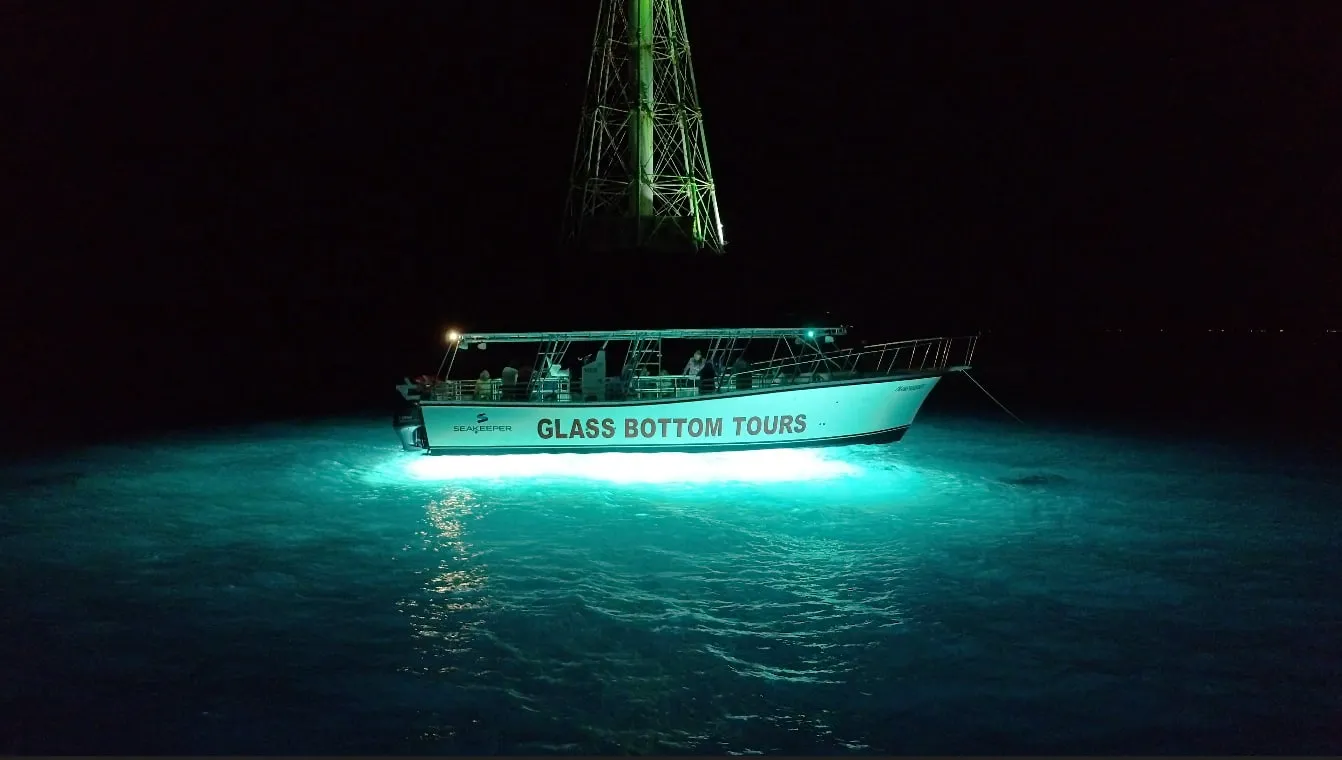
The Transparensea’s night tour is the only glass bottom eco tour operating after dark in Islamorada. It starts with the sunset, then switches on underwater lights that illuminate what the daytime reef deliberately hides. Here is what you actually see when you step aboard.
The Underwater Lighting: What It Does That Sunlight Cannot
At 20 feet of depth in open water, sunlight loses most of its red spectrum. What reaches the reef in the middle of the day is blue-shifted, low-contrast light that produces the muted palette most underwater photographs require post-processing to correct. The Transparensea’s underwater lighting system operates in the full visible spectrum at a distance of feet rather than the surface equivalent of 20-foot depth attenuation. The result is color saturation that daytime reef viewing does not produce.
The orange mantle of a flame scallop flickering in a reef crevice registers as orange – not as a dim reddish shape in faded ambient light. The electric blue of a reef fish catching the beam reads as the color it actually is. The white sand channels between coral heads glow against the surrounding darkness of the water column in a contrast that has no daytime equivalent. Guests who have done both tours consistently describe the night reef as more visually striking in specific moments than the daytime version of the same reef – not because it is more beautiful, but because the color and contrast are genuinely different.
The night tour is the most consistently described as “unforgettable” by Transparensea guests. Seats fill before the departure – check the sunset departure calendar at glassbottomtour.com and book your seats. Call (305) 214-5277 with questions.
The Species That Only Appear After Dark
The shift from day reef to night reef is not subtle. The most dramatic change is that the species you can see double – the nocturnal residents who were invisible during daytime tours emerge, and the diurnal species transition to their night behavior modes. Here is what the Transparensea guides identify on a typical night tour:
Moray Eels – Fully Visible for the First Time
During the day, moray eels occupy crevices in the reef structure with only their heads visible, opening and closing their mouths in the respiratory pumping motion that looks like aggression but is simply breathing. At night, they leave those crevices entirely and hunt across the reef surface in full-body extension. A four-foot moray hunting through the coral under the Transparensea’s lights – visible through the hull window in complete profile, moving with the boneless, flowing locomotion that makes them unlike any other reef fish – is one of the encounters that guests most consistently describe as what they did not expect.
Octopus
The common octopus hunts nocturnally throughout the Florida Keys reef system and is almost never seen on daytime tours. At night, they cross the open reef face between shelter holes in a color-changing pattern that the Transparensea guides describe as one of the most sophisticated behaviors visible through the hull windows. An octopus matching the texture and hue of a coral head, then shifting to the sandy channel color as it moves between structures, is a live demonstration of camouflage more precise than anything in a classroom.
Caribbean Spiny Lobster
Florida spiny lobsters shelter in reef crevices and ledge undersides during daylight and emerge after dark for foraging runs across the open sandy patches between coral structures. They move in groups – sometimes in single-file lines that guides describe as migration behavior – and are visible through the hull windows crossing the sand channels in numbers that daytime visitors never see.
Squirrelfish and Soldierfish
These bright red species shelter deep in coral structures during the day and emerge in feeding groups at night. Under the Transparensea’s artificial light, their red coloration registers with full saturation – a color that essentially disappears in the blue-shifted ambient light of a daytime dive or snorkel. Their group emergence from the coral at dusk is one of the clearest visual demonstrations of the diurnal-nocturnal transition on the reef.
Brittle Stars, Sea Urchins, and the Reef Cleanup Crew
The nocturnal invertebrates of the reef surface – brittle stars extending from crevices, long-spined sea urchins moving across the open reef in their deliberate feeding traversal, small hermit crabs working the sandy channels – are invisible during daytime tours and fully active at night. Guides use these species to explain the reef’s nutrient cycling: the cleanup crew that processes the organic matter the day shift produces.
Bioluminescence in the Water Column
The Florida Keys’ offshore waters contain dinoflagellates and other bioluminescent microorganisms that produce visible light when physically disturbed. In the water column around the Transparensea’s lit hull at night, the interaction between the vessel’s lighting and these organisms creates a visual effect that guests frequently try and fail to describe adequately before giving up and saying “you just have to see it.”
Guides explain the biology during this portion of the tour: what dinoflagellate bioluminescence is, which organisms produce it in the Keys water column, and the evolutionary function of light production in single-celled marine organisms. For guests with any scientific background, this section of the narration is consistently described as the most substantive and the most surprising.
The Departure Experience: What the Night Feels Like
The Transparensea leaves Bass Pro Shop – World Wide Sportsman in the last minutes of twilight – the sky still holding color above the horizon, the marina lights beginning to reflect off the water – and reaches reef viewing depth as darkness fully sets in. The transition from ambient dusk to the vessel’s underwater illumination as the water darkens around the hull is a visual moment that marks the beginning of something different from any previous boat experience most guests have had.
The open-air deck of the Transparensea has full shade during daylight tours. At night, that structure becomes a frame for the Florida Keys sky at a location more than 75 miles from Miami. The light pollution profile of Islamorada is significantly better than the mainland, and a clear Keys night – the Milky Way visible above, the reef lit below the hull, the Alligator Reef Lighthouse blinking on the dark horizon – is part of the night tour experience that photographs do not capture adequately.
Night Tour vs. Daytime Tour: The Honest Comparison
Daytime tour vs. night tour
Transparensea Glass Bottom Boat – Islamorada, FL
| Factor | Daytime tour | Night tour |
|---|---|---|
| Departure | 9:30 AM, 12:00 PM, or 3:00 PM | Starts with the sunset |
| Best for seeing | Broadest species range – all diurnal fish active | Nocturnal species: eels, octopus, lobster, crabs |
| Color quality | Sunlight-filtered at depth – accurate but softer | Full-spectrum artificial light – saturated, high contrast |
| Bioluminescence | Not visible | Visible in water column around the lit hull |
| Sky above deck | Ocean horizon views | Florida Keys night sky – low light pollution |
| Suitable first visit? | Yes – ideal for first-timers and families | Yes – also excellent with no prior experience required |
| Uniqueness in market | Glass bottom tours available at other Keys operators | Only glass bottom night tour in Islamorada |
| Most talked about? | Consistently excellent reviews | Guests describe it most often as “unforgettable” |
Should You Do the Day Tour, the Night Tour, or Both?
Both, if your schedule allows – in a specific order.
Do the 9:30 AM tour first. It provides the broadest species visibility and the best daylight conditions for understanding the reef structure: which formations are coral heads, where the cleaning stations are, where turtles rest on the sandy patches. The daytime narration gives you a mental map of the reef.
Then do the night tour. Every nocturnal species the guide identifies, every behavior change he describes, is understood against the reef you already know from that morning. The moray eel hunting across the face of the brain coral you saw at 9:30 AM is a different encounter than the same eel on a reef you have never seen in daylight. The night tour is more striking when you know what it looked like six hours before.
Guests who do both on the same day or across consecutive days describe the pair as the most complete two-hour-each reef experience available in the Florida Keys without a dive certification.
Frequently Asked Questions
What time does the Islamorada night glass bottom boat tour depart?
It starts with the sunset, so departure time shifts with the season. Check the current sunset-based departure time when booking at glassbottomtour.com. Check-in is 30 minutes before the listed departure.
Is the night tour appropriate for children?
Yes. The same accessibility that makes the daytime tour suitable for all ages applies after dark – no swimming required, fully seated, shaded structure, restroom on board. The content of the night tour is particularly engaging for children who have any interest in animals or science. The nocturnal species reveal – the moray eel hunting, the octopus camouflage – is the kind of biology demonstration that creates lasting curiosity. Many families do both the morning and night tour across the same visit.
Is the reef visible through the glass at night?
Clearly. The Transparensea’s underwater lighting provides full-detail viewing through the hull windows in the dark. In many cases, color saturation through the glass at night exceeds daytime viewing conditions, where sunlight at depth reduces the visible color spectrum. The contrast between the lit reef and the dark water column is higher at night than any daytime equivalent.
Does the Transparensea run the night tour year-round?
Yes. The night tour operates year-round on scheduled days, starting with the sunset in every season. The experience shifts slightly with the season – winter departures are earlier and cooler, summer departures run later into the evening. Both versions are excellent. Book in advance; the night tour fills faster than midday daytime departures.
Does either tour run if it’s too windy for the reef?
Neither reef-based tour operates safely in high wind – offshore conditions need to support a comfortable ride to the reef. On those days, the Transparensea switches to the Bayside Eco-tour, cruising Florida Bay for dolphins or winding through the mangrove canals for manatees, iguanas, and birds instead.
The night tour runs year-round and books before the departure date. Lock in your seats at glassbottomtour.com – select the sunset departure for your date and confirm. Questions before booking? Call (305) 214-5277.